





About
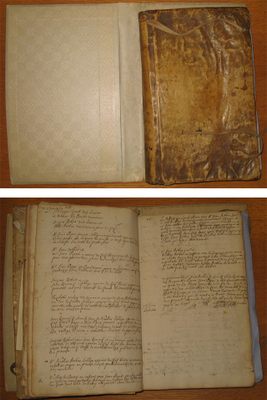
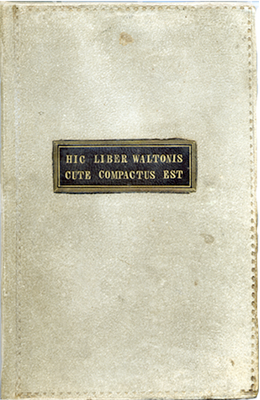
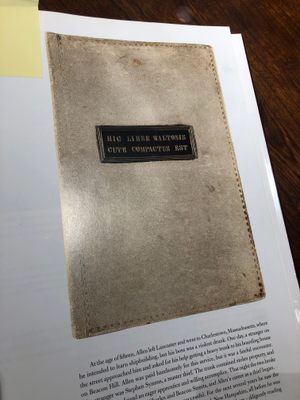
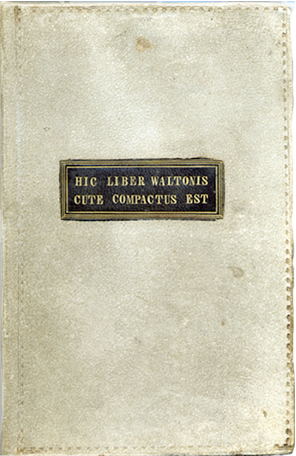
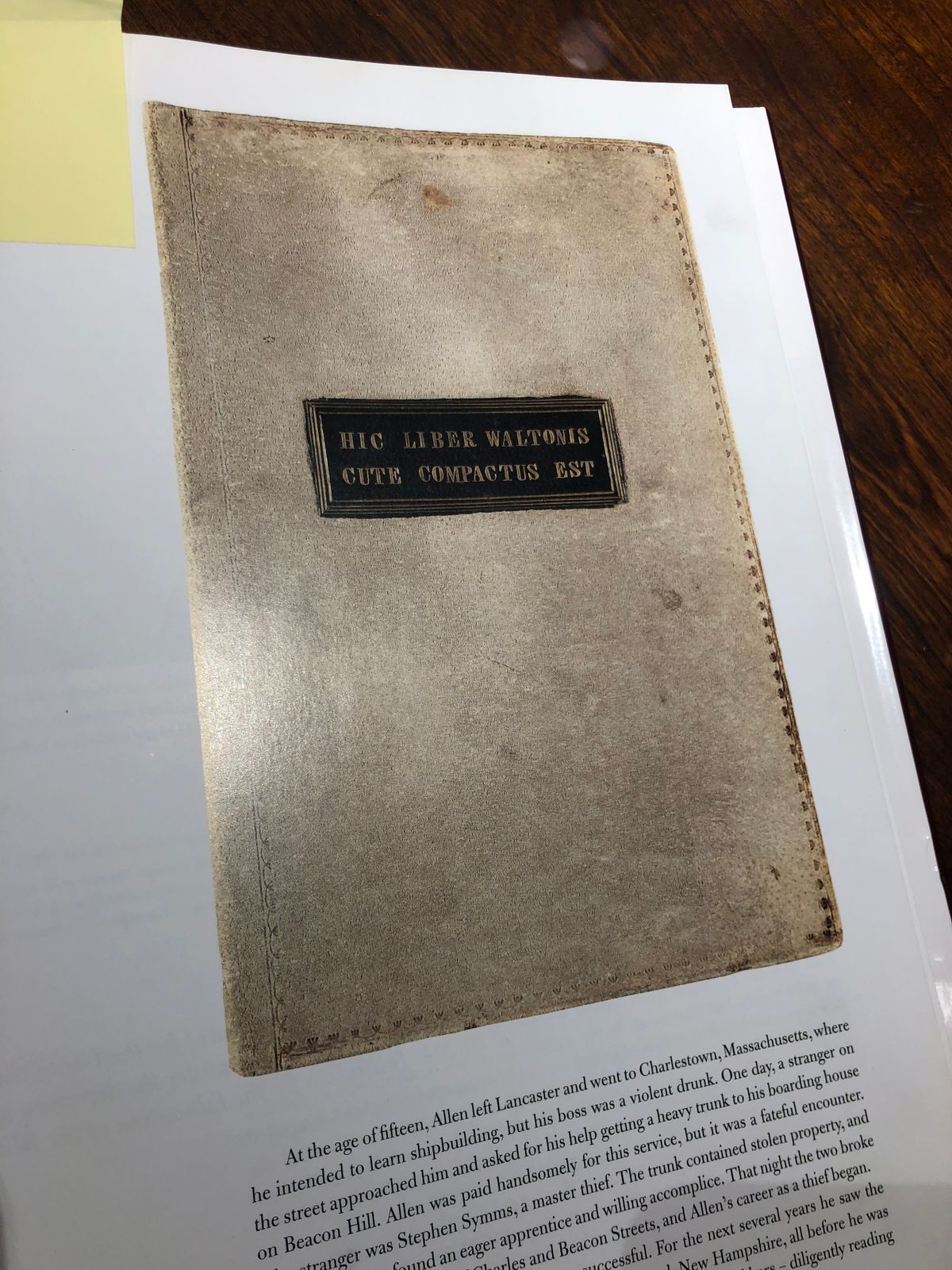
The Boston Athenaeum is home to about 150,000 rare books. But in a locked room, tucked into a custom-made box, there lives a particularly curious one. About the size of an ordinary paperback, the book is a memoir by the career criminal James Allen, alias George Walton. The light gray cover bears the Latin phrase "Hic Liber Waltonis Cute Compactus Est:" "This book was bound in Walton's skin."
Born in Lancaster, Massachusetts in 1809 to a struggling family, Allen fell into a life of crime at the age of fifteen, after a chance meeting with a master thief. He spent most of his life in and out of different jails: while incarcerated, he would read books, learn trades, and get on well with everyone, but as soon as he got out, he would return directly to burglaring and highway-robbing. Eventually, he died of tuberculosis at the state prison in Charlestown, MA.
Before he died, though, Allen decided to tell the story of his life to the prison's warden, and asked him to write it down. He also made a more unusual request: "Allen asked that enough of his skin be tanned to provide bindings for two copies of this memoir," writes Stephen Z. Nonack in Acquired Tastes, an account of the Boston Athenaeum's collections.
One copy of the book was to go to his doctor, and the other was to go to John Fenno, Jr., one of Allen's victims, who he considered to be "the only man who had ever stood up to him," Nonack writes. "A sufficient piece of skin was removed from Allen's back and taken to a local tannery, where it was treated to look like grey deerskin and finally delievered into the hands of... a bookbinder." (You can view the book and read the text at the Athenaeum's website.)
Anthropodermic bibliopegy, or the practice of binding texts in human skin, may date back to the French Revolution, when a number of copies of the French Constitution were supposedly bound in the skin of those who opposed the new Republic. (These can be seen in the in the Museum Carnavalet in Paris.)
By the 19th century, the most common use of anthropodermic bibliopegy was by physicians. Dr. John Stockton Hough bound three medical volumes in the skin of a patient with the first diagnosed case of trichinosis. Others used cadavers they had obtained from public executions.
Books such as the The Dance of Death were being bound in human skin as late as the 1890s. Many of these books now belong to libraries, including the John Hay Library at Brown University, the library of the College of Physicians of Philadelphia, and potentially the Cleveland Public Library and the library of Harvard Law School.
While it is unclear exactly how this skin book got to the Athenaeum, anecdotal evidence suggests it was donated by John Fenno, Jr.'s daughter sometime in the 19th century. There it sits today, describing the life of the man it is also made from.
Update as of July 2021: Allen's skin-bound memoirs is no longer on permanent display.
Related Tags
Know Before You Go
Citing conservation concerns, Allen's skin-bound memoirs are no longer on permanent display, nor are they available to view by appointment. Curious visitors must be content with the digitized version, or be on the lookout for pop-up exhibits that may include the book in the future. Researchers may request to view either of the non-human skin-bound copies that are housed in the Athenæum's collection.
Community Contributors
Added By
Edited By
Published
June 15, 2010
Sources
- http://cdm.bostonathenaeum.org/cdm/ref/collection/p15482coll3/id/4273
- https://www.amazon.com/Acquired-Tastes-Collecting-Boston-Athenaeum/dp/0934552738
- http://articles.latimes.com/2006/jan/15/news/adna-hleather15
- http://histmed.collegeofphysicians.org/skin-she-lived-in/
- https://www.laphamsquarterly.org/roundtable/book-its-cover