Schwebebahn Wuppertal
This "floating railway" is one of the world's oldest monorail systems.
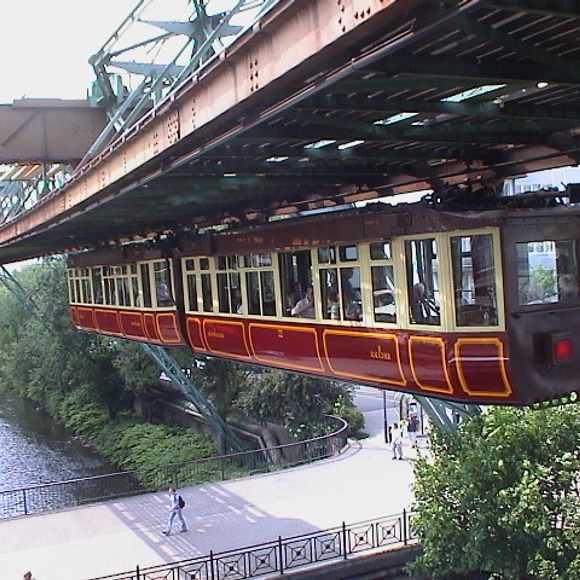
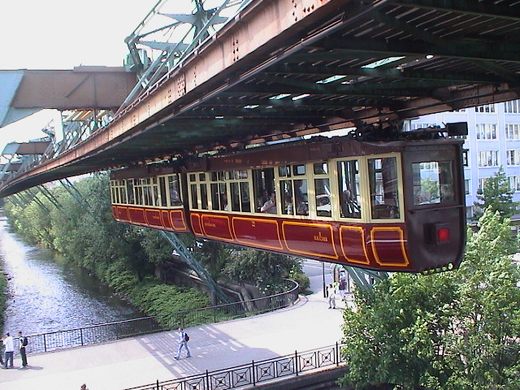
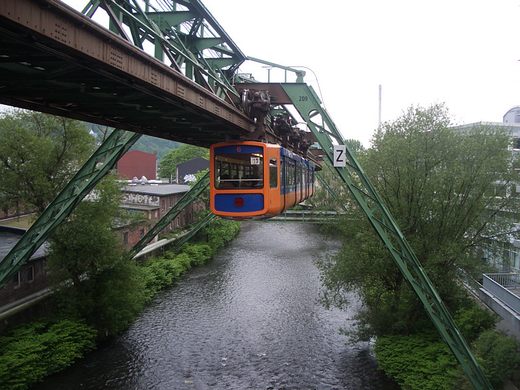
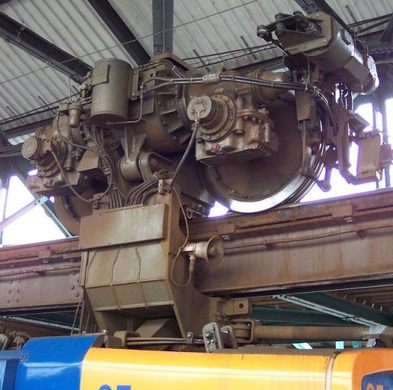
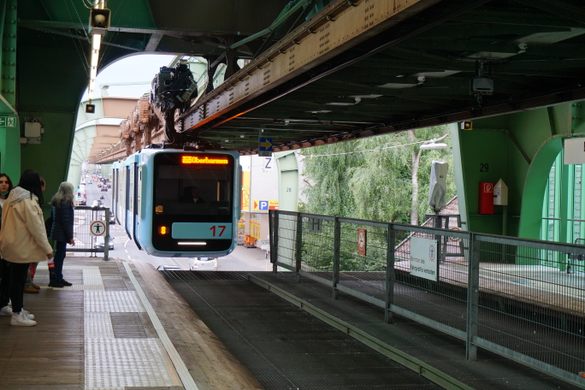
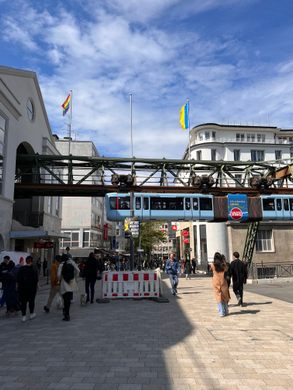
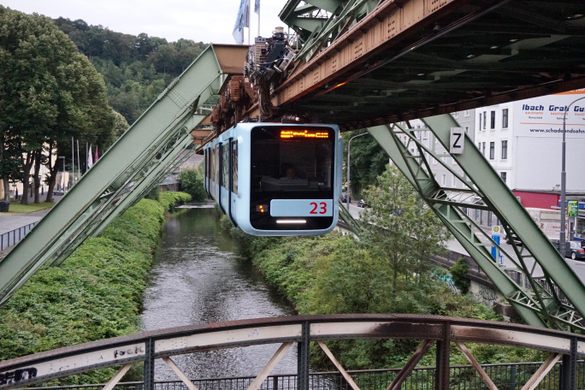
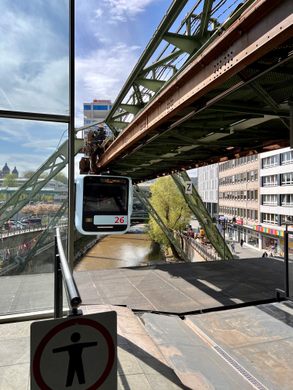
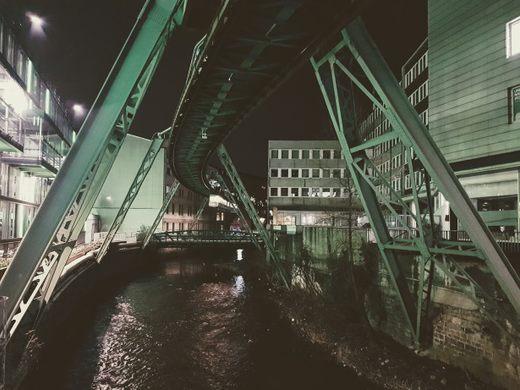
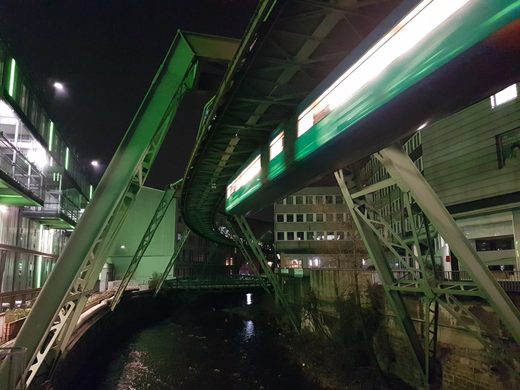
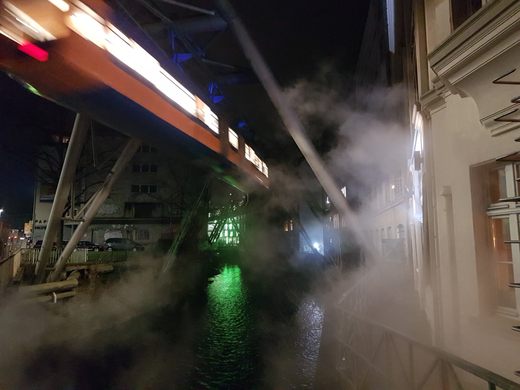
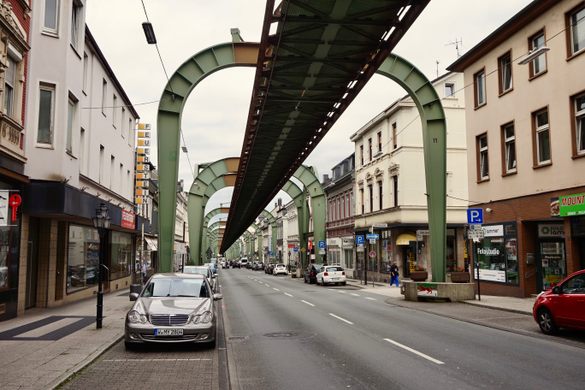
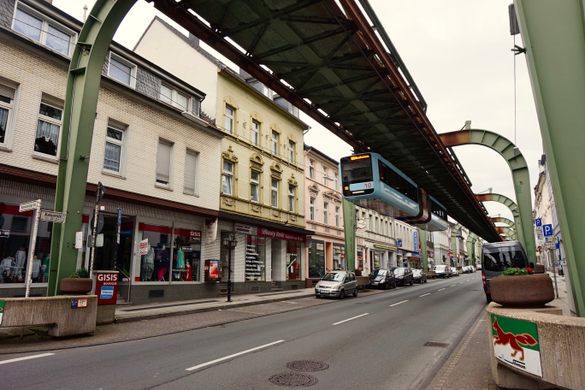
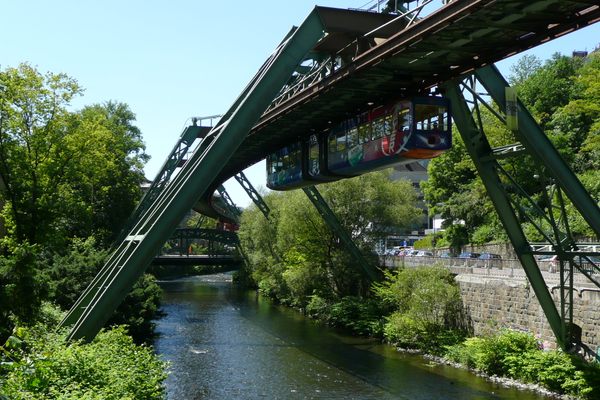

The Schwebebahn Wuppertal, literally translated as the “Floating Railway of Wuppertal,” has a storied past. First, it is the world’s oldest monorail, and, as a “suspended” monorail, it runs by hanging onto a single rail above it. Second, while it is one of the world’s safest transport systems—with an astonishing safety run of ninety six years without a serious accident—it recently had its first fatal crash. And of course, there was that incident with the elephant…
The Schwebebahn Wuppertal (pronounced “Woopertall”) is the most important public transport system in Wuppertal. Mounted on a 13.3-kilometer long, 7- to 13-meter tall iron bridge, the monorail provides a nice view to all who ride on it.
Despite looking like something out of the future, the suspended monorail is quite old. Originally proposed in 1824, the cars were to be pulled by horse teams on the ground. While a prototype was built, the full system was never constructed for political reasons. But in 1898 the idea of a suspended monorail was dusted off, this time to be powered by electricity. Building started in 1901, and by 1903, at a cost of 16 million Goldmark, the monorail was open. Emperor Wilhelm II took the inaugural ride.
The Emperor had nothing to worry about: The Schwebebahn Wuppertal was, and is, remarkably safe. The cars tilt gently with the curves, and the monorail has almost no chance of falling off the track — it happened just once, in 1917, resulting in minor injuries. After, a system was installed to make it nearly impossible for it to happen again. Also, unlike the subway, there’s no chance the monorail will hit people who have fallen or jumped onto the tracks.
From its opening in 1903, the Schwebebahn Wuppertal ran with a nearly perfect safety record — a truck crashed into the rail, collapsing it, in 1968, but there were no trains around — until 1999, when workers failed to remove a metal claw from the track. A train hit the claw at 50 kmph and derailed into the Wupper River below, killing 5 and injuring 49 others. This was the worst and only fatal accident in the monorail’s history.
Recently, in 2008, there was a minor crash when a crane truck moved into the way of the oncoming train and tore a 10-meter rip in the train floor. But, apart from the driver of the truck who broke his leg, the injuries were all minor.
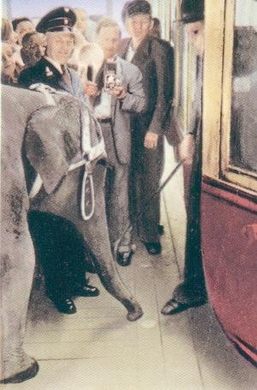
Perhaps the most bizarre accident to occur on the Schwebebahn Wuppertal was that involving a three-year-old circus elephant named Tuffi.
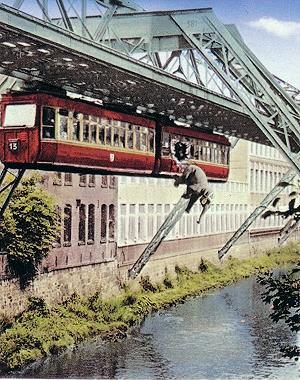
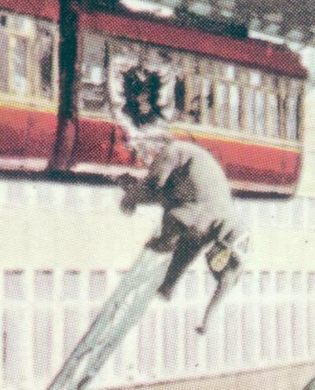
On July 21, 1950, in an attempt to promote its upcoming show, Althoff Circus loaded Tuffi, a young, multi-ton elephant, onto the monorail. This was a mistake. During the ride, Tuffi panicked and burst through the side of the train, falling some 9 meters. Lucky for her, the train was above the Wupper River at the time, and she went splashing into the water. The elephant (along with two journalists and one passenger who were hit by Tuffi on the way out) received only minor injuries. And Tuffi went on to live another 39 years.
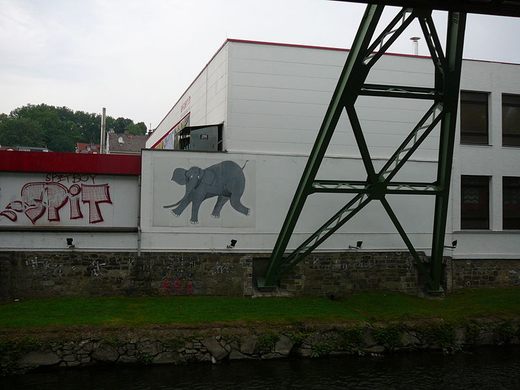
The spot where Tuffi fell is now marked by a painting of an elephant on a nearby building, and there’s an illustrated children’s book about the incident, Tuffi und die Schwebebahn, as well as a local milk brand which still uses the name “Tuffi.”
Community Contributors
Added by





Plan Your Trip
The Atlas Obscura Podcast is Back!




Follow us on Twitter to get the latest on the world's hidden wonders.
Like us on Facebook to get the latest on the world's hidden wonders.
Follow us on Twitter Like us on Facebook