Globe > Europe > Germany > Rostock > Zoological Collection of the University of Rostock
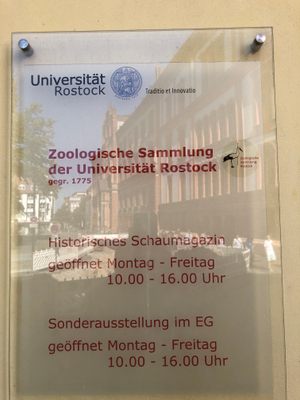
Zoological Collection of the University of Rostock
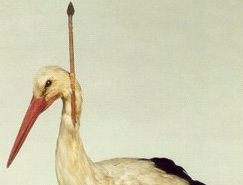
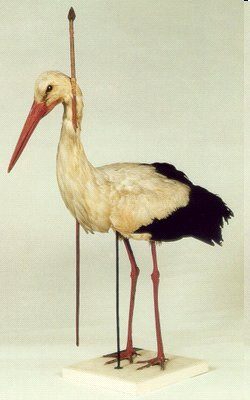
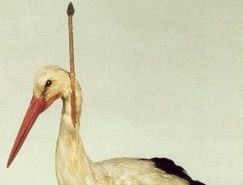
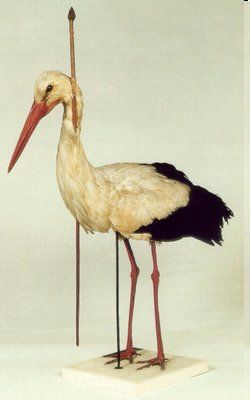
A taxidermied stork with an arrow through its neck proved that birds migrate
Category Strange Science, Natural History
Until the 19th century, the sudden annual disappearance of white storks each fall had been a profound mystery to European bird-watchers. Aristotle thought the storks went into hibernation with the other disappearing avian species, perhaps at the bottom of the sea. According to some fanciful accounts, “flocks of swallows were allegedly seen congregating in marshes until their accumulated weight bent the reeds into the water, submerging the birds, which apparently then settled down for a long winter’s nap.” A 1703 pamphlet titled “An Essay toward the Probable Solution of this Question: Whence come the Stork and the Turtledove, the Crane, and the Swallow, when they Know and Observe the Appointed Time of their Coming,” argued that the disappearing birds flew to the moon for the winter.
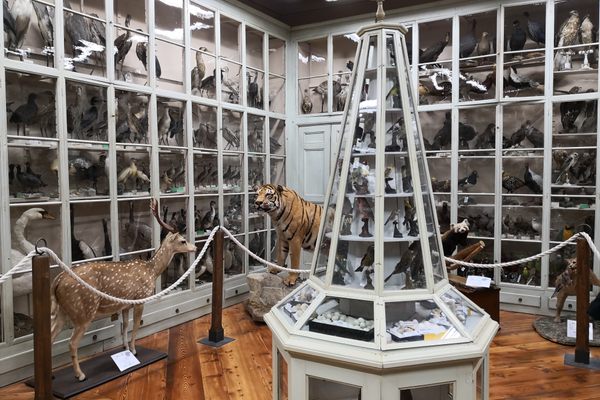
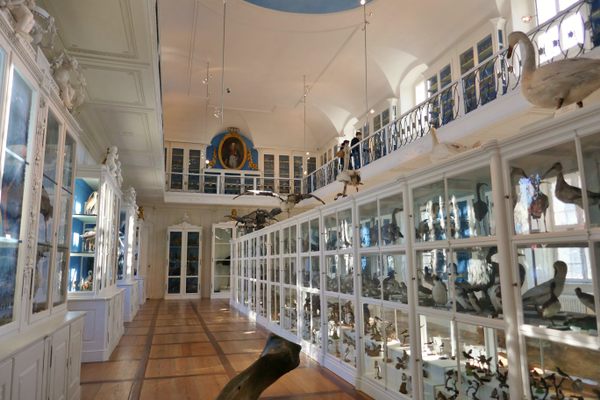
On May 21, 1822, a stunning piece of evidence came to light, which suggested a less extra-terrestrial, if no less wondrous, solution to the quandary of the disappearing birds. A white stork, shot on the Bothmer Estate near Mecklenburg, was discovered with an 80 cm long Central African spear embedded in its neck. The stork had flown the entire migratory journey from its equatorial wintering grounds in this impaled state. The Arrow-Stork, or Pfeilstorch, can now be found, stuffed, in the Zoological Collection of the University of Rostock. It is not alone. Since 1822, some 25 separate cases of pfeilstorches have been recorded.
See an error? Know more? Edit this place.
- Hours Mon-Thu: 10am - 4pm, Fri: 10am-2pm
- Website University of Rostock Zoological Collection
- Address Universitätsplatz 2, Rostock, Germany
- Cost Free
Comments
-
Anonymous
January 14, 2012
This is definitely a topic that's close to me so Im happy that you wrote about it. I'm also happy that you did the subject some justice. Not only do you know a great deal about it, you know how to present in a way that people will want to read more. Im so happy to know someone like you exists on the web. <a href="http://de.hotels.com/de1638289/hotels-rostock-deutschland/">hotel in Rostock</a> -
Anonymous
January 14, 2012
I've found this very interesting and has a good stuff for the readers and designers. I would be glad to recommend the post for its quality content. Nice post. <a href="http://de.hotels.com/de1638289/hotels-rostock-deutschland/">Rostock hotel</a> -
Anonymous
December 12, 2011
Thank you for the article. I just about passed your we site up in Bing but now I'm glad I clicked the link and got to go through it. I'm definitely a lot more informed now. <a href="http://de.hotels.com/de1638289/hotels-rostock-deutschland/">Rostock hotel</a> -
Anonymous
June 27, 2009
Sometimes I feel like a Pfeilstorche. James Christian Karisia Walking Safaris http://www.karisia.com -
Anonymous
June 26, 2009
I wish the article had documented in more detail the evolution of the hypothesis that birds migrated after this discovery. It would make an interesting story, particularly as it was so late, historically. If anyone had asked me prior to reading this when the phenomenon of bird migration had first been noted, I would have erroneously guessed during the period of Ancient Egypt or Ancient Greece..... If anyone has a bibliography on thes, post it. -
Anonymous
June 19, 2009
Josh, occurrences of Pfeilstorches have been recorded, not stored at a museum. -
I'd love to know where the other 25 pfeilstorches are stored. Do any other museums have a pfeilstorch on display?


Post a Comment