About
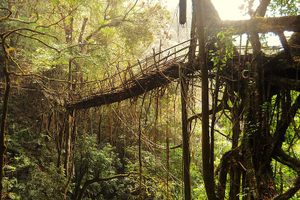
In the depths of northeastern India, within sight of the India-Bangladesh border, in one of the wettest places on earth, bridges aren't built—they're grown.
The southern Khasi and Jaintia hills are humid and warm, crisscrossed by swift-flowing rivers and mountain streams. On the slopes of these hills, a species of Indian rubber tree with an incredibly strong root system thrives and flourishes.
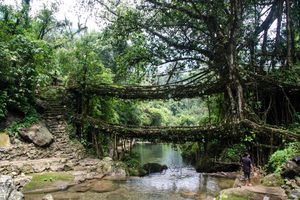
The Ficus elastica produces a series of secondary roots from higher up its trunk and can comfortably perch atop huge boulders along the riverbanks, or even in the middle of the rivers themselves. The War-Khasis and War-Jaintias, two closely related tribes in Meghalaya, long ago noticed this tree and saw in its powerful roots an opportunity to easily cross the area's many rivers. Now, whenever and wherever the need arises, they simply grow their bridges.
In order to make a rubber tree's roots grow in the right direction—say, over a river—the people of southern Meghalaya have used several different strategies. Sometimes, the roots of the trees are simply pulled, tied, twisted, and encouraged by hand to merge with each other, until, over time, they form the desired architectural structure. Root bridges have also been made by creating scaffolds out of wood and bamboo, and then training the young roots out across these temporary structures, replacing the more perishable elements many times as they rot in the intense monsoon seasons.
In some places, such as around the village of Nongriat, betel nut trunks, sliced down the middle and hollowed out, are used to create root-guidance systems. The thin, tender roots of the rubber tree, prevented from fanning out by the betel nut trunks, grow straight out. The trunks also have the added advantage of providing the roots with additional nutrients as they decay. When they reach the other side of the river, they're allowed to take root in the soil. Given enough time a sturdy, living bridge is produced.
The root bridges can grow for as long as the organism they are a part of remains healthy, though they can take many years to initially become functional, the length of time being dependent on local conditions such as the health of the tree, the way the bridge is being grown, and the availability of nutrients in the soil that its being grown in. However, once root bridges become established, they're extraordinarily strong—strong enough that some of them can support the weight of 50 or more people at a time. In fact, because they are alive and still growing, the bridges actually gain strength over time—and some of the ancient root bridges used daily by the people of the villages around Cherrapunji may be well over 500 years old.
The roots bridges of southern Meghalaya come in a huge variety of shapes and sizes. They have been known to grow as long as 170 feet, and soar 80 feet above the streams they cross. Most living root bridges only have a single span, yet several have more than one, arranged as either as two parallel spans, or as two bridges stacked one over the other, such as the famous "Umshiang Double-Decker Root Bridge."
The practice of creating new living bridges, and of preserving ones already in existence, is over large parts of Southern Meghalaya slowly fading out. In many villages across the region, the root bridges are little more than a memory. However, since they began attracting attention again in around 2004, local dedication to the bridges has, at least in a few places, kept them from being destroyed in favor of steel ones. What's more, a few new root bridges are currently under construction. In the village of Rangthylliang, an entirely new bridge is being grown using a bamboo and wood scaffold, and at the double-decker site in Nongriat, a new, third span is currently being grown above the other two, and should be ready for use within a decade.
The Atlas Obscura Podcast is a short, daily celebration of all the world's strange and wondrous places. Check out this episode about the Root Bridges of Cherrapunji.
Related Tags
Know Before You Go
While there are dozens of root bridges, which can be found all throughout the valleys between (very roughly!) the towns of Mawsynram and Dawki, few of these are easily accessible, or have nearby tourist facilities. To visit the bridges in the more remote areas, a local guide is an absolute must! A number of these bridges can be reached from Cherrapunjee Holiday Resort. Local maps to the bridges are available from the Resort. The "Umshiang Double-Decker Root Bridge" is located in the village of Nongriat. Visitors can walk here from the small village of Tyrna. The village is accessible from Cherrapunjee by shared or private taxi. From the village, 2500 steps must be traversed to reach Nongriat. The walk takes about 1.5 - 2 hours each way. Nongriat offers basic accommodation to visitors, so it's possible to stay overnight for a more relaxed experience. Serene Guest House is the best run establishment in Nongriat. From Nongriat, short hikes can lead you to several nearby root bridges, include several upstream from the village, a small, nice one, in the village of Mynteng, and several spectacular examples in the village of Nongthymmai. A large number of living root bridges are known to exist in the jungles around the town of Pynursla. To reach these, many of which are deep in the jungle and require several hours of tough hiking, make sure to find a reliable, local, guide. The Rangthylliang Eco-Tourism society comes highly recommended, and can arrange your stay while in the area. Another option for visiting root bridges is the beautiful, remote, village of Kongthong, which has several in the near vicinity. The Kongthong Travelers Nest is a great base to explore the area from, with several spectacular root bridges within a few hours walk. There's also the village of Shnongpdeng, in the West Jaintia Hills, near Dawki, which can be used as a great staging area to explore several villages with root bridges. Recommended are Kudeng Rim, Padu, and Burma. All of these villages have very little in the way of tourist facilities, so make sure to ask for help planning your visit in Shnongpdeng! Please respect the area's natural surroundings.
Delhi and Rajasthan: Colors of India
Discover Colorful Rajasthan: From Delhi to Jaipur and Beyond.
Book NowCommunity Contributors
Added By
Published
July 22, 2009
Sources
- http://babakoto.eu/Articles/India/Cherrapunjee/Cherrapunjee-English.htm
- http://www.twobirdsbreakingfree.com/ultimate-guide-to-cherrapunji.html
- http://www.cherrapunjee.com/rootbridges.php
- http://www.indiabeat.co.uk
- http://www.cherrapunjee.com.
- https://livingrootbridges.com/threats-to-meghalayas-botanical-architecture/
- https://knowledgeofindia.com/trek-to-rainbow-waterfall-in-meghalaya-detailed-guide-to-rainbow-falls-meghalaya/
- https://footloosedev.com/living-root-bridge-nongriat/
- https://www.lostwithpurpose.com/nongriat-root-bridges/
- https://www.lostwithpurpose.com/guwahati-shillong-cherrapunjee/
- https://livingrootbridges.com/